

Defrosting frozen meat has always been a kitchen routine headache. Leave it on the counter? Risky. Microwave it? Hello, partially cooking your steak edges. But there’s a method that expert chefs have relied on for years, and it works just as well at home: using your sous vide setup to defrost food safely, evenly, and quickly.
This guide is for home cooks and professional chefs looking for a safe, efficient way to thaw frozen food. Sous vide defrosting offers a safer, more consistent alternative to traditional thawing methods, preserving food quality and reducing risk. Sous vide defrosting uses precise, controlled temperatures to gently defrost food in a vacuum-sealed bag without compromising texture or flavor.
Quick answer: Can you defrost with sous vide, and why use it?
Yes, you can safely defrost with sous vide—and it’s a game changer for anyone who regularly cooks from frozen. A water bath kept between 3–4°C (37–40°F) or in the cool acceleration zone of 25–30°C (77–86°F) for under 2 hours can thaw meat, fish, and ready meals faster than a fridge while maintaining food safety standards.
Unlike microwaves, which create uneven thawing with a cooked outer rim and frozen center, sous vide circulates water at a precise temperature around your sealed bag. Countertop thawing at room temperature invites bacterial growth in the danger zone, while basic cold water methods using running water lack the temperature control needed for consistent results.
GIIP manufactures precision sous vide circulators (1100–1400W) designed to hold a stable low temperature for hours—ideal for both defrosting and cooking in the same vacuum sealed bag without ever touching the food.
Why sous vide defrost wins:
- Even thawing from edge to center with no hot spots
- Minimal texture damage and up to 95% moisture retention
- Keeps food out of the danger zone when done correctly
- Seamless transition from defrost to sous vide cooking for home cooks and commercial kitchens alike
Why sous vide is perfect for defrosting food
Sous vide started as a low temperature cooking method developed in the 1970s for preventing juice loss in delicate proteins. That same precise temperature control makes it naturally suited for controlled thawing.
Circulating water keeps the entire bath at one exact temperature, so frozen steaks, chicken thighs, fish fillets, and vacuum sealed leftovers defrost evenly from edge to center. Because the food stays in a sealed bag, there’s no contact with cold tap water, no dilution of flavor, and reduced cross-contamination risk.
This cooking method avoids the “cooked rim, frozen core” problem seen with hot water and microwave thawing. Commercial kitchens can safely move frozen stock from freezer to GIIP commercial sous vide tanks during busy services—especially around holidays when inventory runs high. It’s particularly valuable for high-value cuts like ribeye and tenderloin, plus delicate seafood like salmon and scallops where texture and taste really matter.
How to defrost food using sous vide: step-by-step
This process works for most meats and fish, whether you’re a home cook or managing a professional kitchen. Here’s the clear, repeatable method:
(1) Choose your temperature based on timing needs. (2) Ensure food is properly bagged in a vacuum bag or quality freezer bag. (3) Set up your GIIP circulator and sous vide container with enough water. (4) Submerge bags fully, using clips or racks to prevent floating. (5) Monitor time based on thickness. (6) Decide whether to cook immediately or chill again.
For reference: a 1-inch (2.5 cm) 250g steak thaws in 45–60 minutes at 25°C, while a 1.5kg whole chicken requires 3–4 hours at 3–4°C. GIIP devices with app/Wi-Fi control let you set a defrosting program and receive notifications when it’s time to start cooking or ice-bath chill.
Choosing the right sous vide defrost temperature
Two main approaches exist for sous vide defrosting:
Near-fridge temperature (3–4°C / 37–40°F): Maximum safety, stays completely out of the bacterial danger zone. Thawing is slower—roughly 1.5–2× faster than fridge alone—but GIIP circulators maintain this precisely.
Cool acceleration (25–30°C / 77–86°F): Faster thawing for well-sealed, clean meat you’ll cook immediately. Keep total time under 90–120 minutes.
Never set defrost temperature above 40°C without starting the actual cook, as this risks food safety issues and partially cooking surfaces while cores remain frozen.
Quick guidance:
- Thin chicken breasts (1–2cm): 30–45 minutes at 25°C
- Pork chops (5cm): 90–120 minutes at 4°C
- Fish fillets: 45–60 minutes at 3°C
- Small cuts and ground meat: 30–45 minutes at 25°C
Bagging and placing frozen food in the water bath
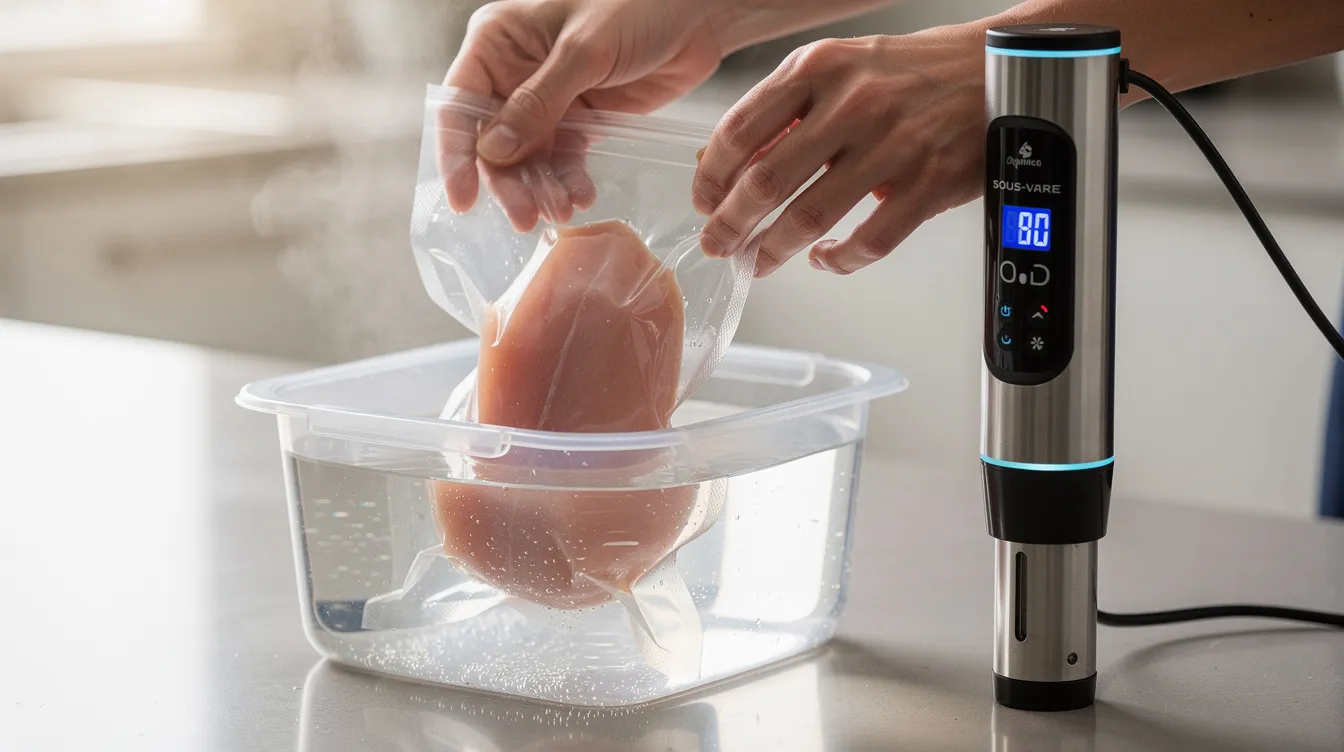
Food must be in a high-quality, heat-safe vacuum sealed bag or thick freezer-grade zipper bag. Re-bag supermarket packaging unless it’s clearly labeled food-safe at sous vide temperatures—especially important for thawing fish and pre-portioned meats where botulism risk exists in anaerobic packaging.
Remove as much air as possible using a vacuum sealer or the water-displacement method to maximize heat transfer and prevent floating. Ensure full submersion with GIIP racks or stainless clips, keeping bags away from the circulator intake. Space bags so cold water circulates freely; avoid stacking thick frozen items in a crowded bath.
Clear labeling with cut type, weight, and freeze date helps restaurants rotating inventory plan accurate defrost times.
From defrost to cooking: one continuous process
Once fully thawed, increase the same bath to your cooking temperature without opening the bag. Example: thaw a frozen 2.5cm ribeye at 25°C for 60 minutes, then raise to 54°C (129°F) for medium-rare, finish with a 60-second sear at high heat.
If cooking straight from fully frozen, add 30–60 minutes to normal cooking time depending on thickness. GIIP’s app scheduling can automate this: defrost in the afternoon, step up to cooking temperature, and hold until you’re ready to eat.
This approach means fewer surfaces touched, fewer dishes, and lower cross-contamination risk compared to moving thawed meat between cutting boards.
Packaging and equipment: doing sous vide defrost safely
Successful sous vide defrosting requires the right bags, clean water, and reliable equipment—not just correct temperature.
Vacuum bags must be food-safe, BPA-free, and rated for at least 70–90°C even when defrosting at low temperatures, allowing cook-in-bag transitions. For vacuum-packed fish and seafood, food safety risks from anaerobic Clostridium botulinum spores mean re-bagging and prompt cooking are essential.
GIIP’s vacuum bags and pumps handle long sous vide sessions and repeated freezing cycles. Keep a dedicated sous vide container cleaned between uses—GIIP offers tanks in sizes from home kitchens to commercial volumes.
Important food safety rules when defrosting sous vide
The danger zone (4–60°C / 40–140°F) is where bacterial growth accelerates. Pathogens like Salmonella double every 20 minutes above 7°C.
Essential rules:
- Keep cool acceleration defrosting under 2 hours
- Never use warm water above 40°C just to speed thawing
- Cook thawed food immediately or rapidly chill in an ice bath (50% ice cubes, 50% cold water)
- Never refreeze raw thawed product—cook first, then chill if needed
- Use a probe thermometer on large cuts: fully thawed meat should read 0–4°C throughout
Always wash hands, sanitize surfaces, and clean your circulator after handling raw poultry or meat.
Cooking from frozen vs. defrosting first: which is better?
Sous vide offers flexibility—you can cook food directly from frozen or defrost first. Both methods are safe when executed correctly.
“Better” depends on protein type, thickness, your schedule, and desired finish. Cooking from frozen offers convenience; defrosting first gives more control over seasoning and searing.
Cooking straight from frozen with sous vide
This is the most convenient method: drop a fully frozen, pre-bagged steak or chicken breast directly into a bath at final cooking temperature.
General rule: add 30–60 minutes to usual cooking time for the core to reach target internal temperature. This works best for evenly frozen, flat cuts—2–4cm steaks, boneless chicken thighs, pork chops, and firm fish portions.
Season before freezing (salt, herbs, butter) for batch-prepped meals. GIIP’s timers and remote control let you start a frozen bag before leaving work, coming home to food held at perfect temperature.
Defrosting first, then cooking
Defrost-first is ideal when you need to inspect the meat, adjust trimming, or change seasoning. Fully thawed meat is easier to marinate, inject, or dry-brine—especially for whole chicken, duck, or pork shoulder.
This method gives better control over browning when searing, since surfaces can be patted completely dry. For fish and seafood, it’s safer from a botulism standpoint—you can re-bag in fresh, oxygenated packaging before cooking.
Example workflow: thaw salmon fillets at 4°C, re-bag with lemon and herbs, cook at 50°C, quick sear to finish.
Which option to choose in real-life scenarios
- Busy weeknight dinner: Cook from frozen—pre-portioned steaks and chicken breasts go straight from freezer to bath
- Hotel breakfast service: Defrost overnight at 4°C for consistent morning prep
- Fine-dining tasting menu: Defrost first for presentation control and perfect crust
- Bulk meal prep: Freeze pre-seasoned portions, cook directly from frozen
GIIP commercial clients standardize written protocols specifying when to thaw first versus cook from frozen, keeping kitchen staff consistent.
Is sous vide defrosting safe? Food safety in detail
Sous vide can be one of the safest defrosting methods because of precise temperature control—provided time, temperature, and packaging are managed correctly.
Bacteria multiply fastest in the 4–60°C zone, which is why leaving food on the counter or using hot water creates risk. GIIP devices hold stable temperatures for extended durations, making it easier to stay out of unsafe ranges than improvised methods.
Defrosted raw meat must reach safe internal temperature before serving: poultry to 74°C (165°F) following USDA guidelines, or equivalent sous vide pasteurization times. Food that’s been above 4°C should not be refrozen raw.
Essential safety tips to follow
- Set timers or use GIIP app alerts—don’t accidentally leave food in a cool bath for hours
- Use an ice bath for rapid chilling if you’ve thawed but aren’t ready to cook
- Re-bag store-bought vacuum-packed fish before sous vide; cook immediately after defrost
- Clean circulator housing, water tank, and racks after defrosting raw chicken or pork
- Take extra care when serving immunocompromised individuals, pregnant people, or children
Practical tips, FAQs, and using GIIP gear for sous vide defrost
Planning ahead makes sous vide defrosting seamless. Pre-bag portions before freezing, label with weight and date, and keep a simple log of times that worked well.
Common questions:
- Ground meat: Flatten into thin portions before freezing for faster, even thawing
- Mixed bags (chicken plus vegetables): Thaw separately due to density differences
- Pre-cooked frozen meals: Safe to reheat via sous vide at serving temperature
- Reusing bath water: Keep for secondary cold-water thaw next day, but change regularly for hygiene
GIIP’s range—compact home circulators with Wi-Fi, 1400W commercial models, and compatible vacuum bags—creates a complete freezer-to-plate workflow. Experiment with your frozen staples: chicken thighs, ribeye steaks, salmon portions. Notice how sous vide defrosting preserves flavor and texture while fitting your recipe needs.

Conclusion: Sous vide isn’t just for cooking—it’s the smarter way to defrost
Sous vide defrosting is faster and more even than the fridge, gentler than the microwave, and safer than room temperature or hot water methods. It’s the last option you’ll need to try before making it your default.
This method preserves texture, juiciness, and flavor—especially for premium cuts and delicate seafood—and integrates seamlessly with sous vide cooking in the same bag. No extra dishes, no cross-contamination risk, no uneven cooking.
If you frequently cook from frozen or manage a busy kitchen, consider adding a GIIP sous vide circulator and vacuum system to your workflow. Browse GIIP’s sous vide kits, commercial tanks, and bags, or request a quote to build a reliable, safe defrost-and-cook process that works for your kitchen.